Enterprise Infrastructure Lab
Router-on-a-Stick VLAN Trunking, Proxmox VE, and AI-Driven Automation
Security Motivation
This infrastructure was architected in response to the inherent security risks of shared apartment Wi-Fi. Recognizing that standard consumer routers lack the granular control required to protect local devices, I designed a private, segmented network that prioritizes data integrity, local AI compute, and absolute control over traffic flow.
System Architecture
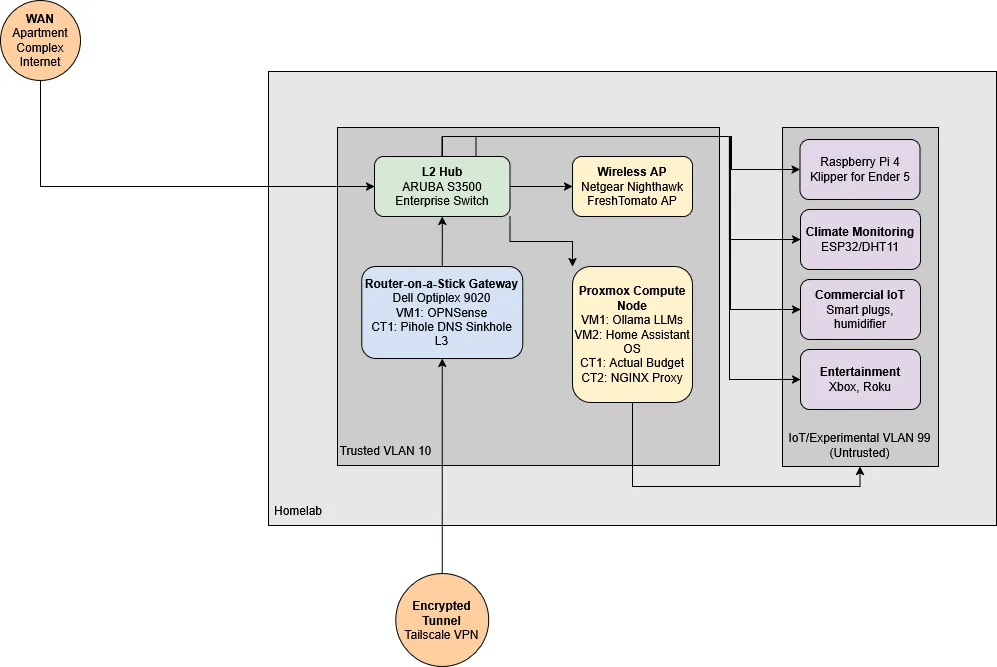
Core Routing & Router-on-a-Stick Fabric
The backbone relies on an Aruba S3500 Enterprise Switch acting as the central Layer 2 distribution hub using a Router-on-a-Stick topology.
- Physical Port Tagging & WAN Ingress: Raw ISP WAN traffic enters directly into an isolated WAN-tagged port on the Aruba switch, which trunks the traffic up to the firewall gateway.
- Gateway / Firewall (OPNsense): A dedicated Dell OptiPlex appliance processes WAN, inter-VLAN routing, and strict firewall policies over a single 802.1Q trunk interface.
- DNS Sinkhole (Pi-hole): Network-wide ad-blocking and telemetry interception occur at the DNS layer, ensuring no device leaks data outside the network.
Core Compute & Virtualization Stack
At the center of the trusted network is a high-availability Proxmox VE compute node hosting virtual machines and LXC containers for localized processing and edge routing.
- Virtual Machines (VMs):
- Home Assistant OS: Centralized IoT engine orchestrating localized climate control (humidifier, ESP32 temperature monitoring), fabrication hardware (3D printer monitoring and controls), media devices (Roku, Xbox), and smart plug power metrics.
- Ollama LLM Instance: Dedicated virtual machine hosting local, air-gapped Large Language Models. Runs the Qwen model, which interfaces directly with Home Assistant to enable local, private natural language device control.
- LXC Containers (CTs):
- NGINX Proxy Manager: Edge reverse proxy managing SSL encryption and routing internal traffic across custom wildcard domains under
*.lab.jbfueston.com. - Actual Budget: Self-hosted, end-to-end encrypted personal finance ledger.
- NGINX Proxy Manager: Edge reverse proxy managing SSL encryption and routing internal traffic across custom wildcard domains under
Secure Remote Access & Ingress
To maintain 24/7 visibility without exposing management ports directly to the public internet, I implemented a hybrid access strategy combining encrypted tunnels with internal proxying.
- Subnet Routing (Tailscale / WireGuard): The OPNsense gateway operates as a Tailscale Subnet Router, providing zero-trust, authenticated access to internal subnets from remote devices.
- Internal Wildcard Routing: Internal services are cleanly addressed via custom DNS entries pointing to the local NGINX proxy, giving edge services dedicated
*.lab.jbfueston.comendpoints.
Physical Port VLAN Hardening
The network enforces physical port-based 802.1Q segregation directly at the Aruba switch level to isolate unsafe hardware from core compute resources.
- VLAN 10 (Trusted Network): Contains primary compute nodes, administrative interfaces, and trusted personal endpoints.
- VLAN 99 (Unsafe / IoT Network): Sandboxed IoT zone mapped to physical ports housing smart plugs, 3D printer telemetry, media boxes, and ESP32 microcontrollers.
- Egress & Inter-VLAN Rules: OPNsense firewall rules strictly limit IoT devices on VLAN 99 from initiating connections to VLAN 10 or unauthorized external endpoints.